


VAGUE SPOILERS TO FOLLOW OKAY!?
This is an exclusive thread for members of pocket observatory. I am going to ramble about some initial thoughts I had after seeing Dune 2.
If you'd like to talk with me in the comments, about the movie, the books, or anything else you think about while reading my rambling, please do! I'll respond and we'll chat!
And yeah, I've included screenshots of the billionaire arguing with me below. Just scroll!
I should start this by acknowledging I am not just not that into the book Dune. I know this might be surprising! I love sci-fi. I love weird stuff! I love convoluted storylines! So shouldn't I love Dune? There was a version of me who did. But I am not her anymore.
Even when I engage with the book as a product of its time, I get too distracted by Herbert's use of women, his orientalism, his unsettling emphasis on genetics as destiny (that's eugenics!) and the whole Golden Path thing.
Now, I think there are nuances worth considering. I really appreciate this essay from Doctoral Researcher in Colonial and Postcolonial Studies Haifa Mahabir, for example,
I think it is appropriate that Albert Einstein, the theoretical physicist and refugee who escaped Nazi persecution at the rise of the Third Reich, once wrote: “The most beautiful thing we can experience is the mysterious.” The notion implies that beauty lies in the unknown; it is precisely in our differences. But in our flawed human natures, we fear this unknown—and it is that fear so uniquely weaponised against us; a civilising mission of profit at any price, that waves an ever-bloodstained flag of Western values and ‘Democracy’. I think Frank Herbert, perhaps of his own inherent volition, understood exactly this. Because in spite of Dune’s orientalist romanticizing of the Middle East and her cultures, faiths, and peoples, the writer more importantly acknowledges a shared humanity and potential, and he dares to imagine a future that rescues humanity from its own abyss. As flawed a work as it may be, Herbert doesn’t make enemies of the Arabs. - Frank Herbert's Dune and Orientalism, Haifa Mahabir
And I think a person can have great taste and love Herbert's work. Dune is just very much not for me. Which is okay!
I've liked the movies more than the book.
Denis Villenueve is one of my favorite directors for many reasons, including how he portrays women. I think Arrival is basically a holy text. Which I talk about in this Young Adult Movie Ministry interview.
But I was concerned when I read Villenueve was taking on Dune.
I abhor how Herbert used women in the books. I really, really didn't want to see a Villenueve-directed Dune that ended the way the book ended, with Lady Jessica telling Chani she needn't despair about Paul marrying someone else. Jessica tells Chani that his wife,
...will have the name, yet she'll live less than a concubine—never to know a moment of tenderness from the man to whom she's bound. While we, Chani, we who carry the name of concubine—history will call us wives.
Oh, okay. So the men get titles like Messiah and God Emporer in the present. But in the future, long after they've died, Chani and Jessica will be called wives. Okay? Plus, doesn't that like really suck for Paul's wife? Why should she have to suffer for Paul's destiny and Jessica's future dignity? Booooo!
Anyways.
The second movie doesn't end with the wives line. And both movies give many of the women as much autonomy as the existing storyline will allow. Maybe more. The later books cannot logically exist in a timeline with the film versions of the women.
I made a quick instagram post about the changes Villenueve crafted for women in the movie. In a comment, a dear friend pointed out that he flattened the Bene Gesserit. I think that's true. They are a much more interesting group in the book.
I wish we'd gotten a nuanced view of the Sisterhood because I think they are worth interrogating. In the books, they have the authority to subversively influence with a superpowered soft power - sex, suggestion, voices, maternal figures, reproductive planning. Basically, an exaggerated version of the soft power elite women have tried (more and less successfully) to wield in real life.
In the movies, women without that authority are allowed to be subversive. While the Bene Gesseritt appear merely power hungry. I don't think Villenueve does an excellent job explaining that Sisterhood hope to use that power to save humans from destruction. I wish all women were allowed their depth, in movies and elsewhere.
And also.
I've known men who've seemed certain that soft power actually works like the Bene Gesserit superpower. That they are really controlled by women's voices and women's bodies. They've used that belief to justify a lot of violence against women. And they've used that belief to deny women lots of other kinds of authority, mostly the kind of authority that is actually powerful.
When I posted about this on Threads, a lot of people said, What about the REAL people in REAL power in the books?! The Women! The Bene Gesserit use their voices and bodies to control the empire! And then, in later books there is an order of women who control men through sex enslavement!
And like, let's look at this statement:
“Yes, the men hold all political power and all fire power and all resource power. But the women are REALLY the most powerful because they can USE THEIR VOICES to CONTROL MEN and ALSO THEY ENSLAVE MEN WITH SEX.”
And um.... that’s a classic misogynist definition of Women.
I stopped looking at my responses shortly after Dustin Moskovitz, a co-founder of Facebook and Asana jumped into them? He is worth almost $20 billion. Why is he responding to my Thread? He's very into effective altruism. I am not sure that arguing with a struggling writer about Dune is the most rational use of his valuable time.
I've included screenshots below. But if you'd rather read on Threads, here's a link. I guess he won't be donating to Pocket Observatory anytime soon. Shame.
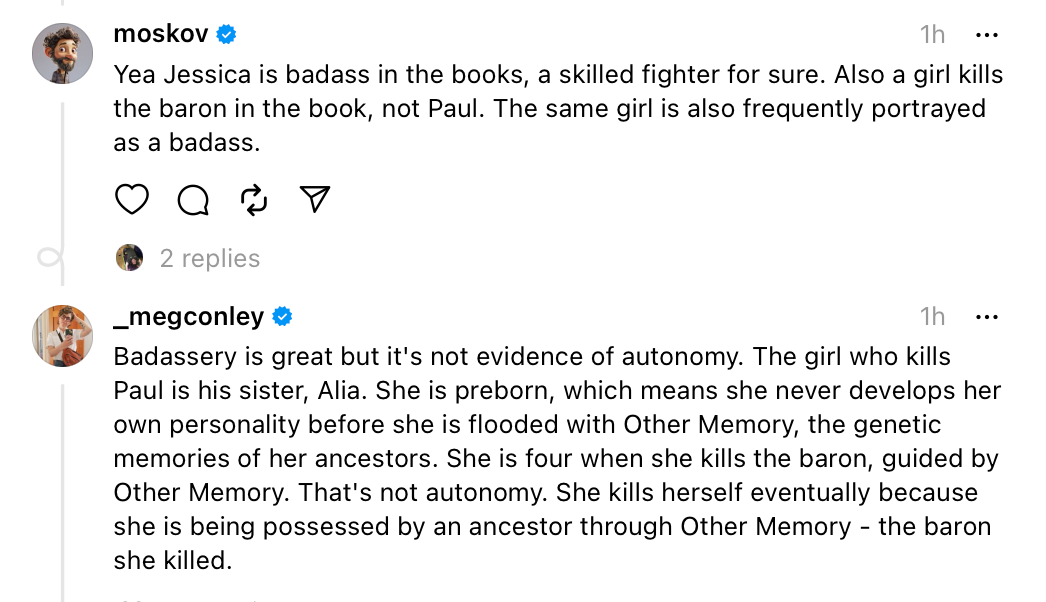
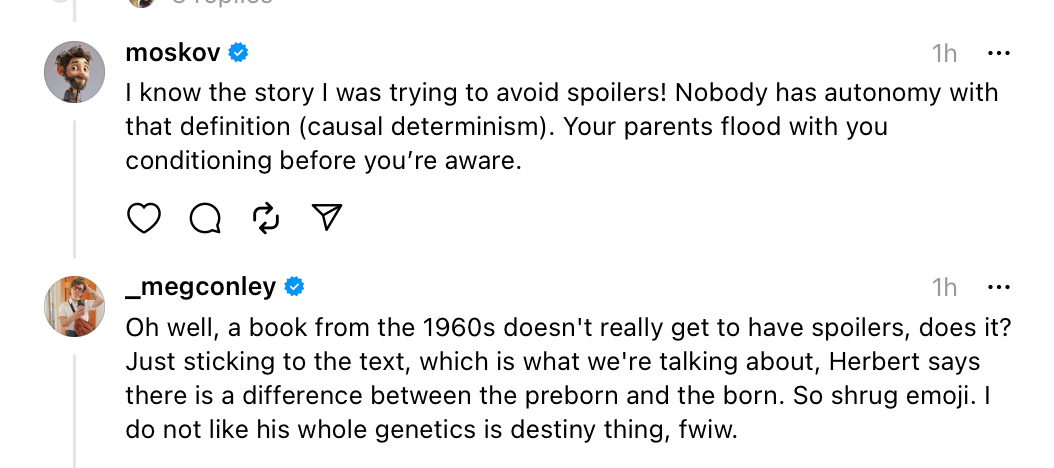
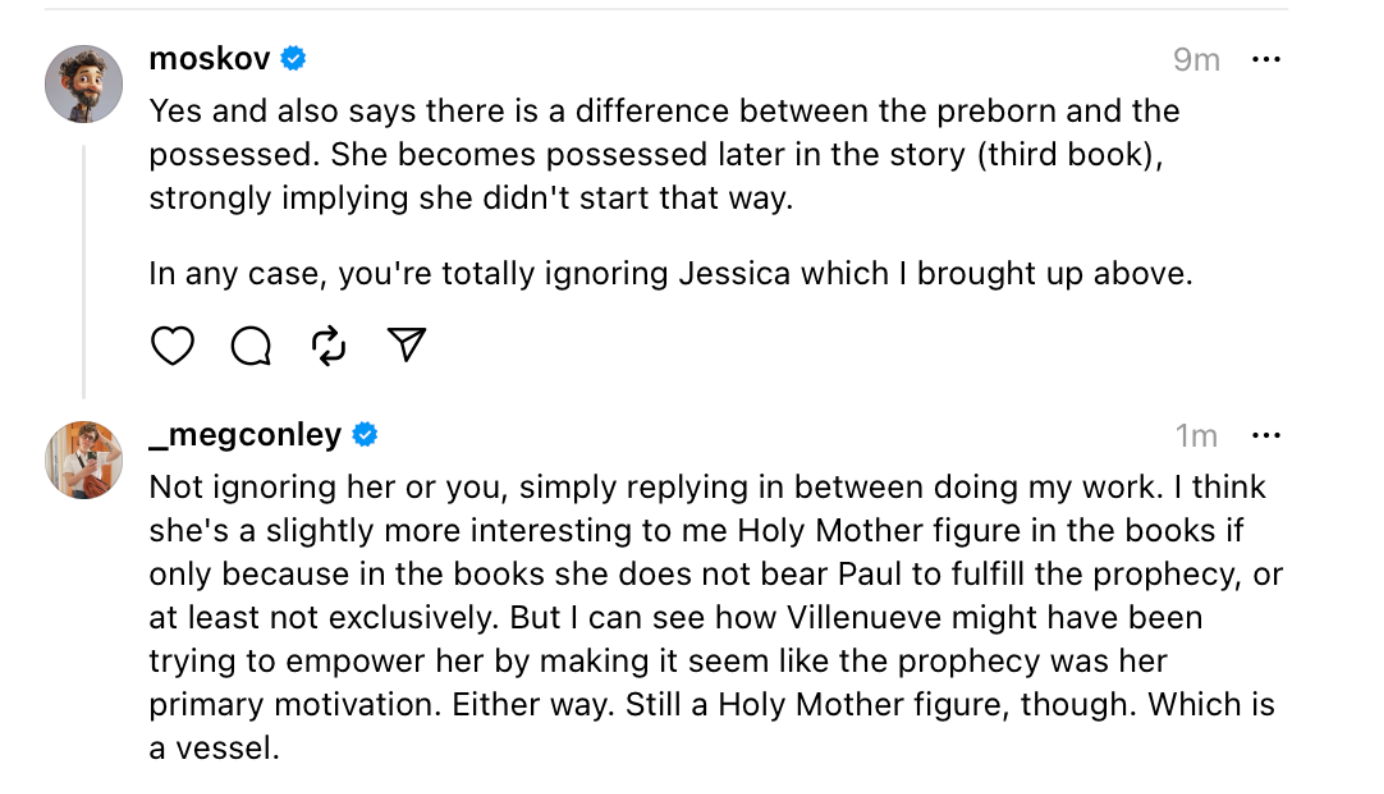
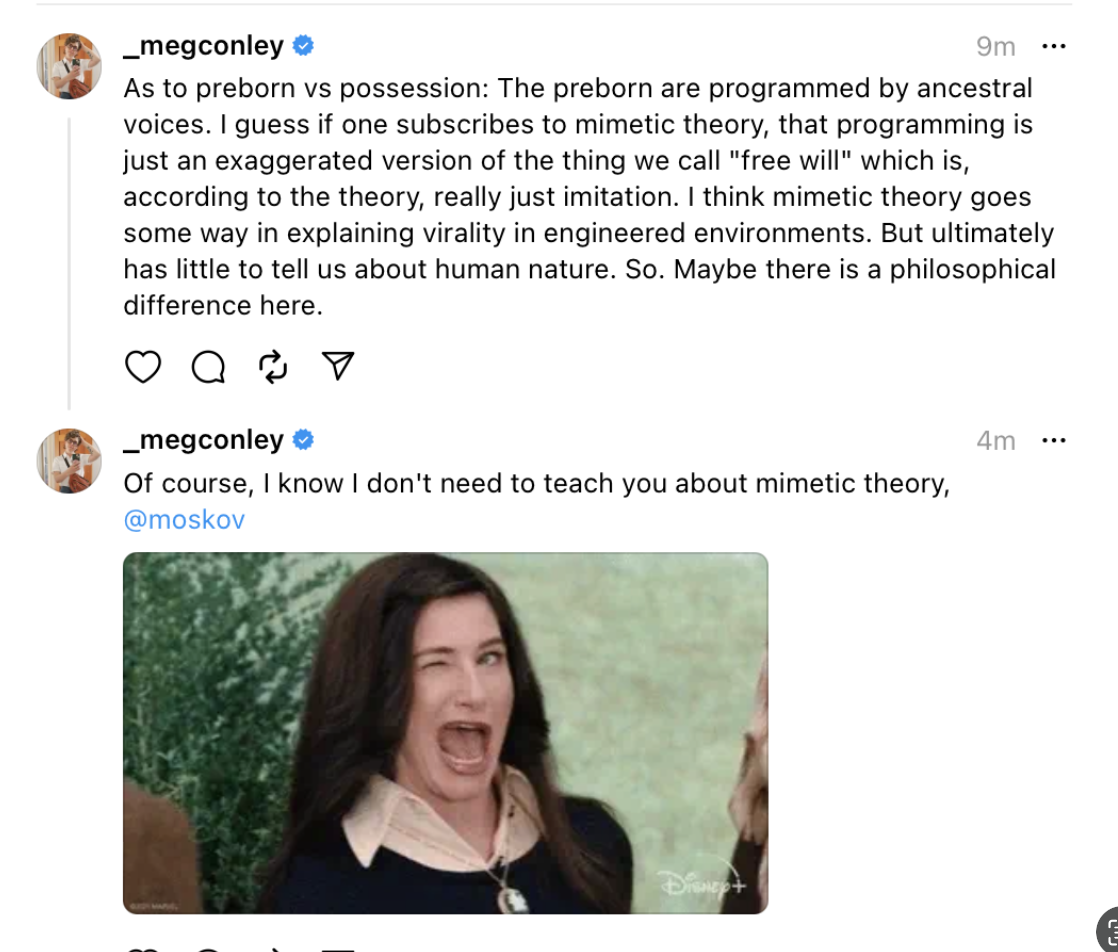
I think there is more to dig into here. Like the way it seems Dune 1 and Dune 2 are in conversation with Arrival, another movie featuring a mother with the gift of sight. In one movie, a sighted mother seems poised to endanger the universe. In another, she helps save the world. Or the amazing black and white sequence. Or the way so much sci-fi has been so influenced by our perceptions of ancient Rome.
But right now, I just want to end with a problem I do not think Villenueve overcame. And one that many people say he made worse. The erasure of "Middle Eastern, North African and Muslim influences" from the story.
Quoting from two essays I hope you read,
I’ve only now watched both David Lynch’s 1984 and Denis Villeneuve’s 2021 film adaptations of Dune. Lynch’s adaptation is rather absurd (and a well-deserving casualty of Mel Brooks’ 1987 sci-fi parody, Spaceballs). The novel’s Middle East and North African influences, presence, and significance are nearly entirely absent, but I wouldn’t expect more—the film is suited to the 1980s theme of cultural and historical irreverence in American popular culture.
In far contrast, Villeneuve is aware of the Middle East and North Africa’s exotic capital in the twenty-first century landscape of a global war on terror—and the re-emergence of the Arab world depicted in film as beautiful and mysterious in its peoples and traditions, and deadly. The Fremen are explicitly Middle Eastern nomadic peoples, against a familiar desert landscape that compels images of the Sahara, or the remnants of an ancient civilization in Wadi Rum. We hear Arabic spoken throughout the film. What is glaringly left out is that there are no Arabs cast in any significant, speaking role—confirming only that our presence for Villeneuve isn’t a reckoning against our history of foreign wars and colonization. Rather, true to the imperial spirit, the movie absorbs itself in our culture and language, while we are erased altogether. - Frank Herbert's Dune and Orientalism, Haifa Mahabir
And also,
Speaking on his decision to turn away from Arab influences, Part One screenwriter Jon Spaihts said, "The Arab world was much more exotic in the 1960s than it is today. Today the Arab world is with us, they’re our fellow Americans, they’re everywhere… What you can really see is that to Frank Herbert’s worldview, just dipping into Islam and dipping into the Arab world was sufficiently exotic to be science fiction. And now… you’d have to go farther afield to make science fiction."
Of course, it's important to note that Dune: Part Two isn't the only franchise to take inspiration from different cultures; this is a common occurrence across film and TV, especially in the sci-fi genre. The movie is set 10,000 years in the future, meaning that while the characters might bare resemblance to the modern day, they are also lightyears apart. It's true that it's nothing short of a cinematic masterpiece – the near-perfect reviews are right about it's incredible cinematography, performances and scores – but that doesn't negate the clear erasure I feel...
While Dune: Part Two is an incredible film, it took direct inspiration from Islam, North Africa and the Middle East yet gave little to no credit or recognition for its sources. I can't help but think of the time and effort it took me to learn the Arabic pronunciations that Timothée Chalamet, Florence Pugh and Zendaya so casually mispronounce on screen. The film simply relegates its cultural inspirations to exotic, Orientalist aesthetics, which is frustrating at a time where such communities are openly discriminated against and demonised.
We're more than an aesthetic and, in spite of its excellence, Dune: Part Two fails to recognise that. - How Dune: Part Two erases its Middle Eastern, North African and Muslim influences, by Furvah Shah
I just...couldn't stop thinking about the women who've said the movies have made them feel erased. My concerns about the depiction of women seem so small compared to this criticism.
There is a scene in Dune 2 where a Fremen community is being attacked by imperialist ships. Women are weeping and children are frightened. People are being killed. A little boy looks up to the sky, as Harkonnen ships fire down at him and his home. It's incredibly moving. And it took me out of the movie.
Arrakis is not a real place. And Dune is not an accurate representation of any people or culture or anything! And spice, the resource everyone is fighting over, doesn't have a real world counterpart.
But Arrakis is Middle East and North Africa coded. And I've grown up as citizen of a country that uses oil to justify violence in those regions. And my country is currently supplying the fire power and the veto power required to keep missiles falling onto Palestinians.
And I don't know.
It felt wrong to watch Dune's battle sequences with my fingers over my eyes, while Palestinian mothers raise their hands up into the air, sobbing over their children's bodies. Not because Dune can or should change world politics. But because ultimately, despite all the problems I have with the books, Herbert was trying to say something valuable with them. He was trying to say something about extraction, domination, power and war.
Over the weekend, millions of people sat in theaters to watch a depiction of that message cloaked in an Arabic aesthetic. And they left the theaters gushing about the performances, the music and the writing. But how many of them left the theater calling for ceasefire?
Here's a link to donate to the Palestine Children's Relief Fund
I might be too hasty. Art needs time to work on us. But that's how I am feeling right this moment. So anyways. Now it's your turn.